
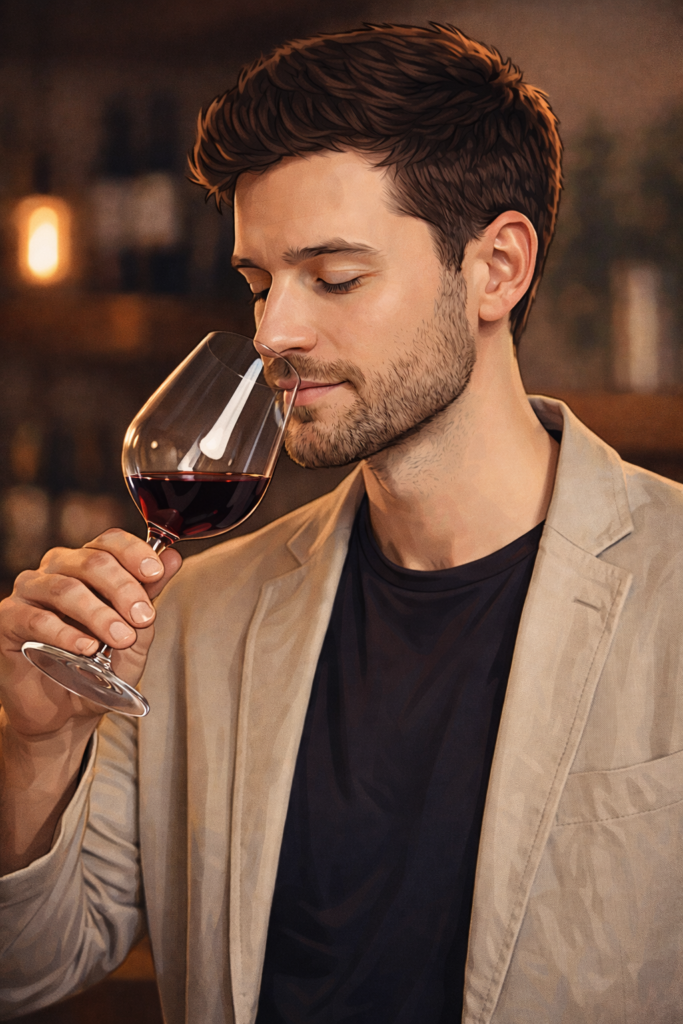
This is where most people freeze.
You smell the wine, your brain panics, and suddenly you’re saying something like, “uh… fruit?” Then you stop talking and hope no one asks a follow-up.
That reaction is completely normal.
The trick with smelling wine isn’t being poetic or impressive — it’s being specific. You’re not trying to name everything. You’re just trying to notice what’s there.
This step comes from the same tasting structure I use throughout this series, based on the Wine & Spirit Education Trust Systematic Approach to Tasting, but it works just as well at your kitchen table as it does in a classroom.
Start with one simple question: does it smell clean?
Before worrying about aromas, I always ask one basic question:
Does this wine smell clean?
Most of the time, the answer is yes — and you move on.
If something smells off, it’s usually pretty clear. Think damp cardboard, vinegar, or something dull and lifeless. You don’t need to diagnose the problem. Just noticing that it doesn’t smell right is enough.
If it smells clean, you’re good. Don’t overthink this step.
How strong is the smell?
Next, I think about intensity.
Is the aroma:
- Light?
- Medium?
- Strong?
That’s it.
You don’t need exact words yet. Just notice whether you have to work to find the smell, or if it jumps out of the glass. This gives you an early clue about the wine’s style and how expressive it’s going to be.
Break aromas into simple groups
This is where things usually go sideways for people, so I keep it very simple.
I think about aromas in three loose groups:
- Primary aromas — things that come from the grape itself
(fruit, flowers, herbs) - Secondary aromas — things that come from winemaking
(yeast, bread, cream, oak) - Tertiary aromas — things that come from time
(dried fruit, nuts, earth)
You don’t need to name all three. You don’t even need to name one perfectly. Just noticing which group you’re in already helps narrow things down.
A tool that helps when words don’t come easily
When you’re learning to smell wine, the hardest part is often putting language to what you already sense. You know there’s something there — you just can’t grab the word.
One thing that helped me early on, and still does, is having a simple aroma chart nearby. Not to memorize. Just to reference.
I like something straightforward like this:
👉 Wine Folly Aroma Wheel Chart
It lays things out in broad categories — fruit, floral, spice, earth — without forcing you into anything overly specific. Sometimes seeing a word is enough to unlock what your nose already recognizes.
I treat it as a guide, not a test.
Youthful or developed?
After that, I ask one more question:
Does this wine smell fresh, or does it smell like it’s been around for a while?
Fresh wines tend to smell bright and lively — fresh fruit, citrus, herbs.
More developed wines often smell softer and deeper — dried fruit, nuts, earth, or spice.
There’s no right answer here. You’re just placing the wine on a timeline.
A quick personal note on smelling
I take short sniffs, then step back.
Smelling wine for too long doesn’t help. Your brain gets tired and everything starts to blur together. That’s called olfactory fatigue, and it happens to everyone.
If I feel stuck, I pause, reset, and come back. Pushing through usually makes things worse, not better.
What this step is really doing
Smelling wine isn’t about naming rare fruits or sounding confident. It’s about building a picture before you taste.
When you slow down here, the palate makes more sense later. The flavors don’t feel random — they feel expected.
That’s the goal.
How I use this in real life
I don’t chase aromas. I don’t force words.
I smell.
I notice.
I move on.
Most of the time, that’s enough to understand what kind of wine I’m dealing with and what it’s trying to do.
Wine Tasting Series
Previous: Reading the Glass: What Wine Appearance Actually Tells You
Coming up next
In the next post, I’ll move on to the palate — how wine actually feels in your mouth, and how to make sense of acidity, tannin, and body without getting lost.