
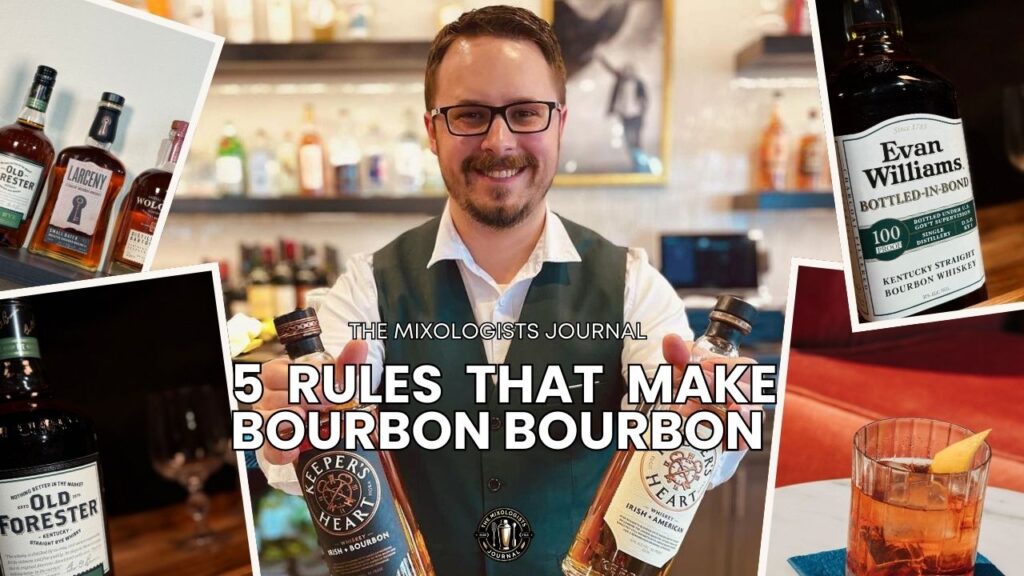
What Makes Bourbon ACTUALLY Bourbon? The 5 Legal Requirements
“All bourbon is whiskey, but not all whiskey is bourbon.”
You’ve heard that a thousand times. But what does that actually mean?
What’s the real difference between that bottle of bourbon and the rye whiskey sitting right next to it?
Here’s the thing—bourbon isn’t just a style or a brand. It’s not marketing. It’s a legally protected category with five specific requirements written into U.S. federal law. And if you miss even one of these rules? It’s not bourbon.
I’m [NAME] with The Mixologists Journal, and today we’re breaking down exactly what makes bourbon bourbon. By the end of this article, you’ll be able to walk into any liquor store and know exactly what you’re looking at, what you’re paying for, and why some bottles say “bourbon” while others just say “whiskey.”
Let’s dive in.
The Big Picture: Why Bourbon Has Rules
Before we get to the five rules, you need to know this:
In 1964, Congress passed a resolution declaring bourbon “America’s Native Spirit.” Just like Champagne can only come from Champagne, France, or Scotch can only come from Scotland, bourbon has legal protection.
These five requirements come from the U.S. Alcohol and Tobacco Tax and Trade Bureau (TTB). They’re not suggestions. They’re law. Every single bottle of bourbon you’ve ever had follows these exact same rules.
Requirement #1: Made in the United States
Rule number one: Bourbon can only be made in the United States.
Not Kentucky specifically—we’ll bust that myth in a minute—but somewhere within the 50 states.
This is what makes bourbon uniquely American. You can make whiskey anywhere in the world, but you can’t call it bourbon unless it’s made in the U.S.A.
Now, about 95% of bourbon is made in Kentucky, and there are good reasons for that—the limestone water, the climate, the tradition. But bourbon is legally made in Tennessee, Texas, New York, Colorado, and other states too.
Key takeaway: If it’s not made in the U.S., it’s not bourbon. Period.
Requirement #2: At Least 51% Corn
Rule number two: The grain recipe—called a mash bill—must contain at least 51% corn.
The remaining 49% can be any combination of grains, typically rye, wheat, and malted barley.
This is huge for flavor. Corn is what gives bourbon that characteristic sweetness—those notes of caramel, vanilla, and butterscotch you taste.
Some bourbons are 70%, even 80% corn—super sweet and smooth. Others hover right around that 51% minimum to make room for spicy rye or soft wheat.
Here’s how that breaks down:
High-corn bourbons (70%+ corn):
Sweeter, smoother, easier drinking.
Traditional bourbons (60–70% corn):
Balanced sweetness with some spice.
High-rye bourbons (20%+ rye):
Spicier, bolder, more complex.
Wheated bourbons (wheat instead of rye):
Softer, sweeter, silkier mouthfeel.
So next time you pick up a bottle, check if the distillery shares their mash bill. It’ll tell you a lot about what you’re about to taste.
Requirement #3: Distilled to No More Than 160 Proof
Rule number three: Bourbon cannot be distilled higher than 160 proof—that’s 80% alcohol by volume.
Why does this matter?
The higher you distill, the purer the alcohol becomes, but the more flavor you strip away. Vodka, for example, can be distilled to 190 proof or higher—which is why it’s basically flavorless.
Bourbon’s 160 proof limit ensures that more flavor compounds from the grains survive distillation.
Most bourbon producers don’t distill anywhere near that maximum. They typically distill between 125 and 140 proof to keep even more character and complexity.
Key takeaway: Lower distillation proof equals more flavor. Bourbon’s proof limit keeps it from becoming a neutral spirit.
Requirement #4: Aged in New, Charred Oak Barrels
This is the big one—the rule that shapes bourbon’s flavor more than anything else.
Bourbon must be aged in new, charred oak containers. In practice, that means brand-new, charred oak barrels.
Why “new”?
Used barrels have already given up most of their flavor compounds to the previous whiskey. New barrels deliver maximum flavor—vanilla, caramel, and oak spice—because the wood hasn’t been exhausted yet.
This is expensive. A new barrel can cost $150–200, and you can only use it once for bourbon. But it’s worth it.
After bourbon is done with them, these barrels are sold to Scotch producers, rum makers, and even beer brewers. One barrel can have many lives—just not multiple bourbon lives.
Why “charred”?
Charring the inside of the barrel caramelizes the wood sugars. During aging, the whiskey pulls those sugars out, creating those classic bourbon flavors—vanilla, butterscotch, toasted oak, and brown sugar.
Barrels are typically charred to levels #1 through #4. Higher char means more caramelization and deeper flavor penetration.
This is why bourbon tastes like bourbon. You can’t fake this with additives or shortcuts.
Requirement #5: Entered Into the Barrel at No More Than 125 Proof
Rule number five: When bourbon goes into the barrel for aging, it can’t exceed 125 proof.
Distilleries usually add water to the distillate before barreling to reach that number.
Why does this matter?
Water plays a huge role during aging. Lower barrel-entry proof allows different flavor compounds to be extracted from the wood. Higher proof can speed things up, but it can also create harsher flavors.
That 125-proof cap is about balance and refinement.
Bonus Rule & What Bourbon Is Not
Bourbon must also be bottled at a minimum of 80 proof.
Now for the myths.
Bourbon does not have to be:
Made in Kentucky
Aged for a specific amount of time
Made with a specific recipe beyond 51% corn
Made by a particular distillery
Some quick examples:
Jack Daniel’s meets all the bourbon requirements but uses additional charcoal filtering, so it chooses to label itself as Tennessee whiskey.
Rye whiskey uses at least 51% rye instead of corn.
Scotch is made outside the U.S. and aged in used barrels.
How to Use This Knowledge
When shopping:
If it says “bourbon,” it followed all five rules.
If it just says “whiskey,” at least one rule was broken.
“Straight bourbon” means it was aged at least two years.
“Bottled-in-bond” means even stricter quality standards.
When tasting:
High corn = sweeter
High rye = spicier
Higher proof = more intensity
Age matters—but it’s not required by law.
Final Thoughts
Here are the five legal requirements that make bourbon bourbon:
Made in the U.S.
At least 51% corn
Distilled to no more than 160 proof
Aged in new, charred oak barrels
Entered into barrels at no more than 125 proof
These rules aren’t arbitrary. They’re why bourbon tastes the way it does—and why it’s different from every other whiskey in the world.
Next time you’re at the liquor store, you’ll know exactly what went into that bottle and what flavors to expect.
What bourbon are you drinking right now? Drop it in the comments and let’s see how many different mash bills we’ve got in this community.
Cheers, and Drink Responsibly,
Erik
Want to learn more about bourbon? Get my free Ultimate Whiskey Guide (13 pages of no-BS bourbon education)
Previous ->
Bourbon Labels Are Lying to You (Here’s What Actually Matters)